By Orrin Grey
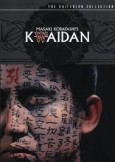 Kwaidan. Director: Masaki Kobayashi. Cast: Rentaro Mikuni, Michiyo Aratama. Country: Japan.
I’m just going to throw this out there: Kwaidan is boring. I know that saying that makes me a philistine, but it’s true. Kwaidan is frequently gorgeous and visually inventive, but it’s also boring. I said last time that Onmyoji is a movie with a surprisingly laconic pace, but compared to Kwaidan, Onmyoji is a Michael Bay film.
I have, as it transpires, seen a lot of movies recently that I found boring for no reason that I could discern. Seventy-two-minute explosion-fests that still left me checking my watch. Kwaidan is nothing like those movies. Not to be too glib, but Kwaidan is boring on purpose. It’s a slow, stately movie, the kind that gets described as “lyrical” and “haunting” and “painterly”. The soundscape of Kwaidan is sparse, punctuated by frequent silences. It’s also three hours long. As you might imagine, a three-hour movie that’s described as “painterly” is not precisely thrill-a-minute.
There are definitely things to recommend about Kwaidan, especially if you’re the kind of person who has the patience for it. The title roughly translates to “ghost stories” and that’s a pretty apt description for this anthology film of four unrelated tales drawn from Japanese folklore as filtered through the writings of Lafcadio Hearn (an Irish-Greek writer who became famous for his collections of Japanese legends and ghost stories after emigrating to Japan).
Kwaidan shines brightest in a lot of its visual choices. There are interesting costumes and carefully chosen colours. Perhaps most interesting: virtually all of the outdoor scenes are shot against impressionistic painted backdrops, with a sequence where the sky fills with watching eyes during a snowstorm a particular visual standout. Unfortunately, some of the segments, especially the first one, suffer from being too dark for the careful design choices to shine through as well as they otherwise might.
The best of the four segments is, without a doubt, “Hoichi the Earless”. Though still slow in places, it is visually stunning from beginning to end, and many of the film’s painterly touches work to their best effect in it. Watching the strange sea battle between the Heike and Genji clans that opens the story is like watching some kind of odd, nearly-silent opera, or like watching a painting come to life. And the later sequences of Hoichi in the graveyard, or of the priests decorating his skin with sacred writing, are equally impressive.
Unfortunately, the ending of “Hoichi the Earless” is changed from Hearn’s original, if only slightly, and to a lesser effect, in my opinion.
The length of Kwaidan, and its measured tread, make it a difficult film, though there are rewards for those with the fortitude to see it through. It won’t be to everyone’s tastes, but if “haunting”, “lyrical”, and “painterly” are the kinds of adjectives that don’t put you off, then you might give it a try.
Purchase Kwaidan from Amazon.com