
By Nick Mamatas
 This article was originally published in Weird Tales, 2009. It is reprinted with permission from the author. Do not reproduce.
For writers, Edgar Allan Poe is a hard man to avoid, especially for those scribes who happen to live on the East Coast of the United States. Not just because Poe created the genre of mystery fiction, founded modern horror by eliminating the moral instruction formerly universal in such stories, and also planted the seed of science fiction. Poe is hard to avoid because Poe was a failure.
There’s a plaque in Boston, a cottage in the Bronx; a building in Philadelphia that has gained the status of National Historic Site; the grave in Baltimore; and a museum in Richmond, Virginia. But Poe isn’t a George Washington figure; important though he is to American culture, we don’t need ten thousand signs detailing places where Poe might have slept. There are a ton of Poe residences and other remembrances partially because Poe moved around a lot in his adult years. Edgar Allan Poe attempted the impossible – to make a living as a writer and editor in the United States during an era when English-language publishing was dominated by the United Kingdom.
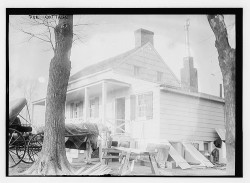 When I first visited the Poe cottage in the Bronx, I was impressed. It was a tiny home – small rooms and a half-attic that served as bedrooms for Poe and his wife/cousin Virginia, and Virginia’s mother. The ceiling nearly scraped against the top of my head – and I am not a tall man – and I could have lain down across the parlor, and with my arms outstretched, hit two walls, but it was still a house. At the time, I was paying $900 a month for an extremely dubious “two-bedroom” apartment in Jersey. Poe’s cottage would have gone for $4,000 easy, in the Bronx. Stick it in Manhattan; that cottage would have been a five-digit rent, if it were first outfitted with electricity and heat. And that’s not counting the basement, in which the park ranger that manages the cottage sleeps as part of the salary for the gig.
But the cottage, which cost Poe $400 a year, was a 19th-century dump. Poe biographer Kenneth Silverman quotes a visitor who said, “You wouldn’t have thought decent people could have lived in it.” Indeed, the home’s long-term survival is explained by the fact that the cottage was miserable and located in an out-of-the-way suburb. It was easy to move to a nearby park when some apartment buildings went up, though Life magazine had to sponsor a campaign to save the structure. A young Jim Thompson was among the thousands who sent in a dollar to save the cottage of his literary hero.
Poe’s career comprised moments of feast interspersed by years of famine. In 1845 alone, Poe lived in three different Manhattan residences: a small house on Greenwich Street, with wife and mother-in-law in a boarding house on East Broadway, and finally, one nice place in a swanky part of town, 85 Amity Street (now West 3rd). Just a few blocks from Washington Square Park and owned by New York University, the Poe House, as it was subsequently called, was recently torn down to create a monstrous new building for the law school. After protests by everyone from Lou Reed to the Mystery Writers of America, and the arrest of a demonstrator who recited “The Raven” through a megaphone, NYU decided to keep the façade of the building and integrate it into the new structure. The end result is the sort of disaster one might end up with after the power goes out and one has to eat whatever is in the fridge for dinner – corn and bacon for everyone! Demolished in 2001, this house was the last extant Poe building in Manhattan.
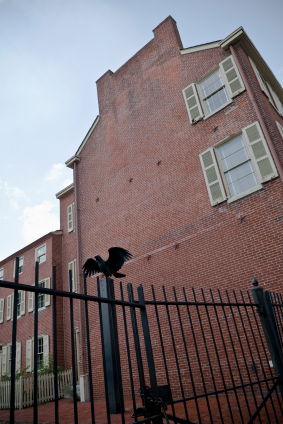 Other cities have had a bit more luck preserving their Poe. The site at 530–532 North 7th Street, Philadelphia, was declared a national memorial by Congress in 1980. Poe lived in Philly for nearly six years and spent 18 months in this building, a near-record, given the number of times he was forced to move by angry landlords and failed publishing schemes. The relative stability of his homestead and Philadelphia’s reputation as the publishing center of the United States did help – Poe wrote over thirty short stories while in Philly, including “The Murders in the Rue Morgue”, and three books. Too bad for Poe, the books were the no-advance, no-royalty deals not unusual back when the distinction between a printer and a publisher was blurry. Philly wasn’t full of much brotherly love, either; in the 1840s, the city didn’t have a police force and plumbing was generally a novelty. Crime and filth filled the streets, as did poverty (Poe was hardly alone in his hunger) and racial strife. Poe generally set his stories in pre-contemporary times, or overseas, but much of the Gothic muck of his fiction was, in truth. just outside his window.
The most famous Poe city is, of course, Baltimore. Poe died there under bizarre circumstances – a disappearance, strange clothes, an Election Day reappearance – and is buried there still. The surviving Baltimore Poe House (oddly, also on an Amity Street) was actually rented by his aunt, Maria Clemm, who was also the mother of Poe’s child bride Virginia, in 1832. Poe was in his early twenties and just beginning to make a small name for himself as a writer and editor, the highlight being an award of 50 dollars from a local newspaper for “MS Found In A Bottle”. By 1836, Poe had left for Richmond, Virginia, and the household quickly collapsed – Maria and Virginia followed Poe south. Like other Poe dwellings, the Baltimore house was preserved due to public outcry – most of the surrounding buildings were torn down in the 1930s to make way for a public housing project called the ‘Poe Homes’. The area is still fairly seedy, which is a more fitting tribute to Poe than the Baltimore city fathers might wish.
The Richmond Poe Museum is in the Old Stone House, a colonial dwelling that was not a Poe residence. It is located near Poe’s Richmond home and the offices of the Southern Literary Messenger. What the Museum lacks in authenticity, it makes up for in sheer perversion. Along with the Poeana (a walking stick he forgot to pack!) and first editions, is an exhibit of the history of speculations regarding the cause of the poet’s death. Beating was an early favorite (1857) and made a comeback late last century (1998).
There are other Poe places. Near the Public Garden in Boston, and just steps away from both Emerson College and the writer’s center, Grub Street Inc., is a plaque commemorating Poe’s birthplace. Manhattan’s Edgar Cafe (West 84th Street) was the site of a farmhouse in which Poe wrote most of “The Raven.” (Try the key lime pie.) If you ever find yourself in Jersey City, in the bad part of town (Greenville) in a housing development called Currie’s Woods, feel free to drink yourself crazy and spend three days and nights running around half-naked and screaming, just like Poe allegedly did in 1842.
There is a dark undercurrent to all of these Poe places. Why so many? Poe was hunting for something in this young America, his own version of the American Dream. He wanted to write, to marry, to be seen as a man of letters and lauded for his creativity. Despite his genius, and the flashes of public recognition he received, Poe was never anything more than a genteel bum during his own life, and an incorrigible troublemaker. He picked fights with Longfellow, plagiarized, and used both non-bylined columns and pseudonyms to review his own material. Indeed, Poe once even attacked himself under the name ‘Outis’ (‘Nobody’) in order to further his campaign against Longfellow. If he were alive today, Poe might be a minor writer but likely a major blogger, punching above his weight class with new controversies and new denunciations every week.
 Poe’s travels up and down the crooked little vein of America were fueled by the most practical of issues: he couldn’t pay the damn rent. He drank heavily, scribbled frantically to keep dimes and dollars flowing in, and lurched from one enterprise to another, none of which cemented his income or his fame. In short, Poe was a loser and a lowlife. A genius, yes, but these other things, as well. It’s so easy to forget this today, given that Poe is taught rather than read, and nothing transforms the transgressive into the canonical like posthumous acclaim.
The truth is in the location of the surviving buildings: Poe lived on the edge, in more ways than one. Every city in which he lived has its own share of Poe history, but the story is generally the same: swampland and slumlords, and after the bills piled up too high a midnight ride to somewhere, anywhere, else.
Poe fan Jim Thompson was fond of saying that there was only one plot in all the world: “Things are not what they seem.” These dusty Poe places, filled as they are with the echoes of the man and his feather quill, not to mention third-grade class trips, are not what they seem. If Poe were half the man the exhibit copy and museum brochures made him out to be, there would be half as many Poe sites left standing. They are not a tribute to American letters but instead, to the Imp of the Perverse, that little demon that drove Poe to both creative heights and abject depths. Like the Imp himself said, “But why shall I say more? To-day I wear these chains, and am here! To-morrow I shall be fetterless! – but where?”
Bio: Nick Mamatas is the author of two novels, the Lovecraftian Move Under Ground and the satirical Under My Roof. His short fiction has appeared in subTERRAIN, Poe’s Lighthouse, Lovecraft Unbound, and many other journals, magazines and anthologies. Much of his short fiction was recently collected in You Might Sleep… A native New Yorker, Nick now lives in the California Bay Area, but misses Boston and the North Shore more than he thought he would.