By Orrin Grey
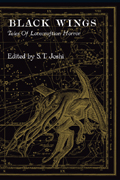 Joshi, S.T. Black Wings: New Tales of Lovecraftian Horror. PS Publishing, 2010. US $40. ISBN 978-1848630611.
Over the years, countless anthologies of original “Lovecraftian” fiction have been released, but when S.T. Joshi’s Black Wings was announced on the heels of Ellen Datlow’s Lovecraft Unbound, it seemed inevitable that the two volumes would be compared. Not only were they two major anthologies with a similar theme being released by two luminaries in the field, their tables of contents (each one a who’s who of modern Lovecraftian fiction) boasted several duplicate contributors.
And yes, comparisons between the two are inevitable, but I’m not here to tell you which one is better than the other. They each do different things, and even the stories by duplicated authors often achieve very different results. The most interesting similarity between the two is that both of them largely eschew Mythos tales and pastiches of Lovecraft’s style. While Black Wings seems less stringently anti-pastiche (or anti-tentacle) than Lovecraft Unbound, you will still find fewer mentions of Cthulhu or the Necronomicon than you might be used to in a Lovecraftian anthology.
Several of the highlights of Black Wings are alumni from Lovecraft Unbound. William Browning Spencer’s story is as good as we’ve come to expect. Laird Barron’s “The Broadsword” is a little closer to his usual cosmic horror than his tale in Lovecraft Unbound, but it’s also a top-notch bit of gruesome fun. Caitlin R. Kiernan offers one of several stories that depart from “Pickman’s Model”, and produces one of the true gems of Black Wings, while Michael Shea (whose “The Recruiter” I enjoyed in Lovecraft Unbound) produces another with “Copping Squid”, which is apparently the title story of his recent Lovecraftian collection.
Some of my other favorite stories came from David J. Schow (“Denker’s Book”), Jonathan Thomas (“Tempting Providence”), and Norman Partridge, who has long been a favourite of mine but who isn’t one of the names that you expect to see in a Lovecraftian table of contents. His story, “Lesser Demons”, is, coincidentally enough, also the title story from his forthcoming collection.
When I reviewed Lovecraft Unbound, the thing that surprised me most was the conspicuous absence of what are often considered the usual trappings of Lovecraftian stories. These are less conspicuous (or maybe just less absent) in Black Wings. While there are still only a few mentions of the Big C or the other usual customers, there are several stories that depart, often brilliantly, from Lovecraft’s own tales, or that use the time-honored tradition of claiming that Lovecraft wrote, at least in part, from life. There’s even a story or two that features Lovecraft himself as a character. Lovecraft Unbound distanced itself from other Lovecraftian anthologies by avoiding these sorts of things. Black Wings doesn’t exactly revel in them, but it doesn’t cross the street for them either, relying on the strong and distinct voices of its authors to keep the stories from falling into the realm of pastiche.
As I said before, it’s impossible not to compare Black Wings to Lovecraft Unbound, but I think it would be equally impossible to say that one was better than the other. If you’re looking for more traditional Lovecraftian fare, Black Wings is probably the book for you, but at the end of the day, both are winners, and we fans of Lovecraft – and of good weird fiction in general – should count ourselves lucky to have either, let alone both.
You can purchase Black Wings through PS Publishing’s website.